
WATER, MEMORY AND DISABILITY
Courtney Jacopino
Elif Shafak’s novel There are Rivers in the Sky records the journey of a single drop of water as it travels across continents and centuries. The water droplet is rendered lively and agentic as it weaves together the seemingly discordant lives of Shafak’s characters. From the book’s outset, Shafak reminds readers that, without water, ‘there would be no life on Earth… and no stories to tell’, positioning water as a finite and precious resource.[1]In doing so, Shafak imagines water as intrinsically bound to memory, experience and the human body, an element that both sustains life and carries traces of the past.
The exhibitions Deep End and Water – by Amy Claire Mills and Hands On Studio respectively – share the artist’s experiences with water and the places that make these encounters possible. Together, the works cultivate a strong sense of joy and community, demonstrating the important social role that water plays in contemporary Australian life, particularly for people with disability. Through bright colours, textured materials and sculptural forms, the artists invite audiences into real and imagined worlds that consider lived experience, embodied perspectives and the natural environment.
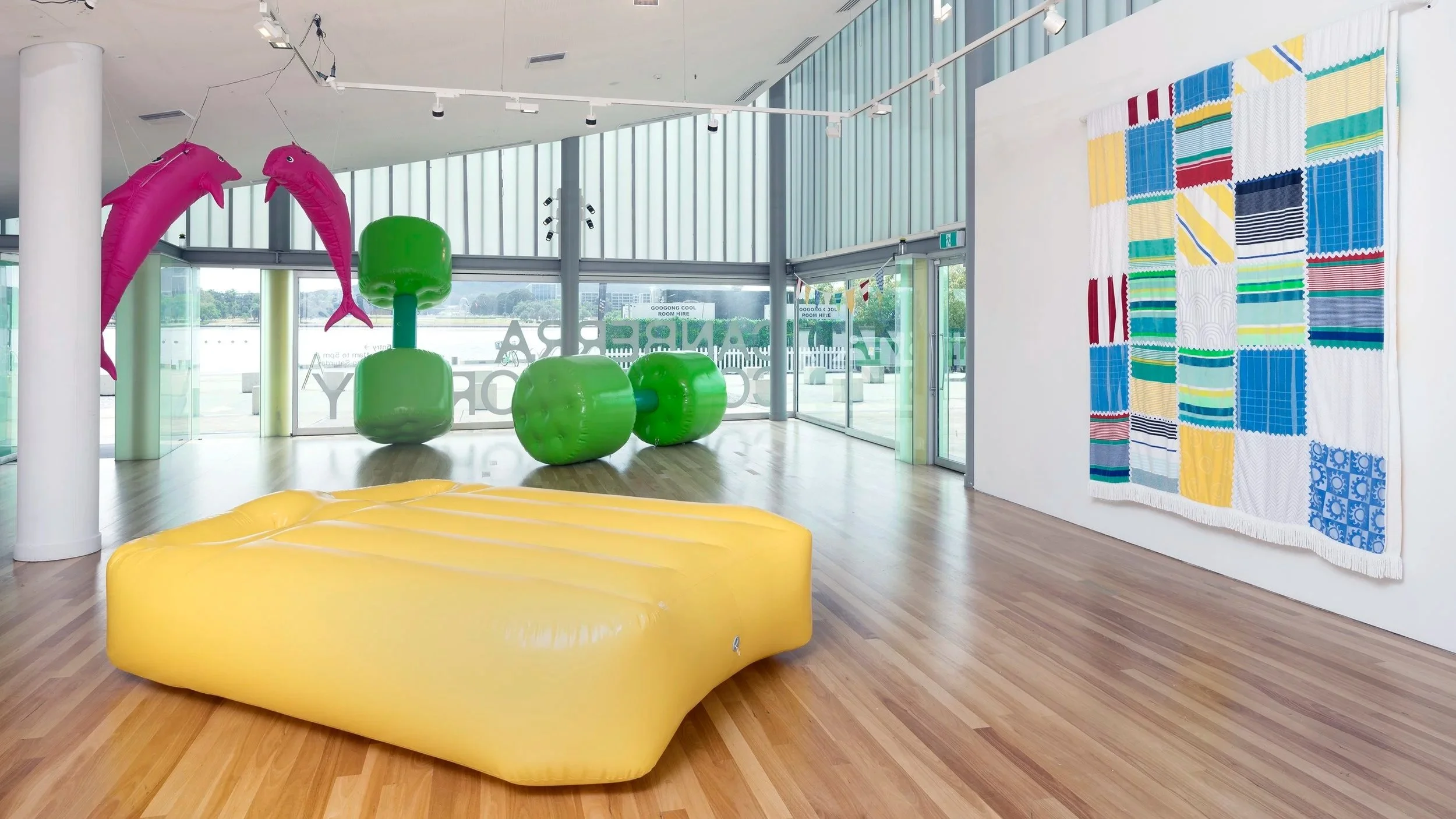
Amy Claire Mills. Installation view of Deep End. 2026. Canberra Contemporary. Photograph by Brenton McGeachie
For many of us, public pools are formative sites of our childhood and youth, places where we learned to swim, played with friends, and discovered the possibilities of our bodies. As inexpensive and accessible spaces, public pools offer opportunities for movement, community and play, providing a brief respite from the pressures of everyday life. Amy Claire Mills’ exhibition Deep End evokes these familiar memories, reconstructing the materials and environment of a pool within the gallery. Mills extends this shared experience to explore the importance of public pools to people with disability.
Deep End critiques modernist modes of artmaking that privileged the visual and sought to isolate processes of perception and understanding from the body.[2] In its place, the exhibition foregrounds bodily and multisensory experience, inviting movement, touch, listening and looking. This approach embeds principles of creative access and is further informed by the current ‘embodied turn’, centring knowledge that emerges through the body.[3] Mills’ works are rendered on a human scale, reproducing familiar pool equipment – rafts, dumbbells, towels and dive toys – at several times their original size. These sculptures incorporate materials that mimic the textures found at a pool, including rubber, synthetic plastic, cotton-blend textiles and ceramic tiles. Light further conjures the atmosphere of a pool, with artificial reflections bouncing off the white walls and silver tiled lettering.
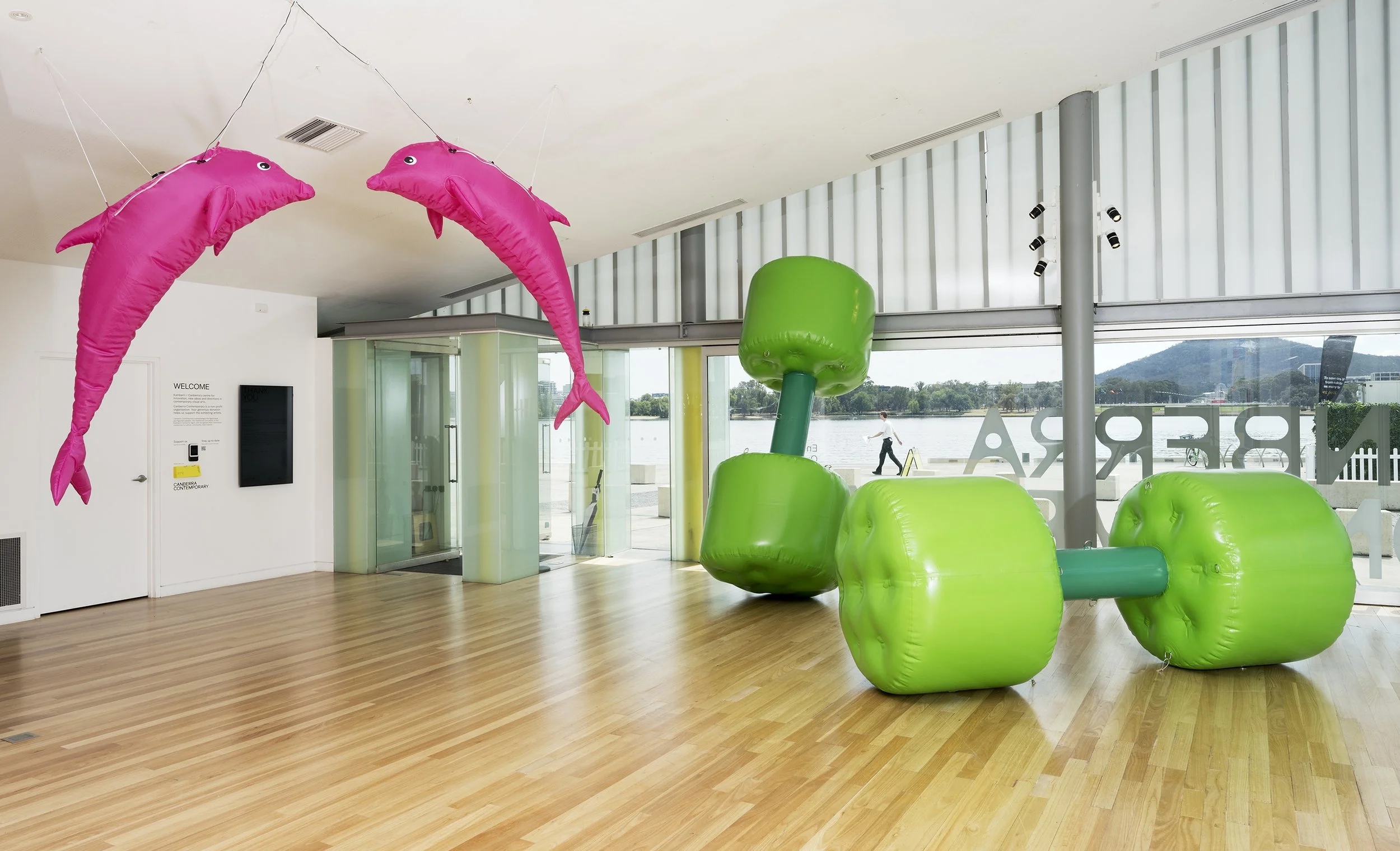
Amy Claire Mills. Installation view (detail) of ‘Deep End.' 2026. Canberra Contemporary. Photograph by Brenton McGeachie.
In her auto-fiction response to Mills’ exhibition, Juliet Phraser reflects on her experience of ‘crip time in the deep end’, describing the therapeutic and social potential of the public pool.[4] Crip theory reclaims the multivalent term crip in order to expose complex systems of power and normalisation within contemporary culture.[5] In doing so, crip theory both ‘makes’ and ‘unmakes’ knowledge about disability, grounded in the lived experiences and knowledges of people with disability.[6] Disability disrupts and distorts time, impacting the duration of daily tasks and achievement of expected milestones.[7] As a result, time may be felt or experienced differently by people with disability, taking on a somewhat ‘slippery’ form. Crip time offers a temporal approach to understanding disability that challenges able-bodied ideologies of productivity, progress and independence.[8] This concept stands in contrast to normative, linear time which presumes sequential life stages.[9] Crip time also challenges dominant capitalist systems in which labour power determines economic and political value.[10]
Disability is commonly understood in relation to time, expressed through medicalised frameworks of symptoms, frequency and management.[11] Providing an alternative to the medical model, crip time describes the effect of disability on one’s orientation in time, often framed through embodied experience.[12] Within a medical context, time may feel stilted or depleted for people with disability, shaped by the seemingly never-ending pursuit of diagnosis, advice and treatment.
The public pool bridges distinct medical and social spaces, facilitating exercise, therapy, connection and play. For people with disability, the pool offers accessible forms of care and community beyond clinical contexts. Mills’ exhibition invites renewed engagement with much-used – yet frequently misunderstood – concepts of access and inclusion, urging audiences to design for the disability community from the outset.[13]
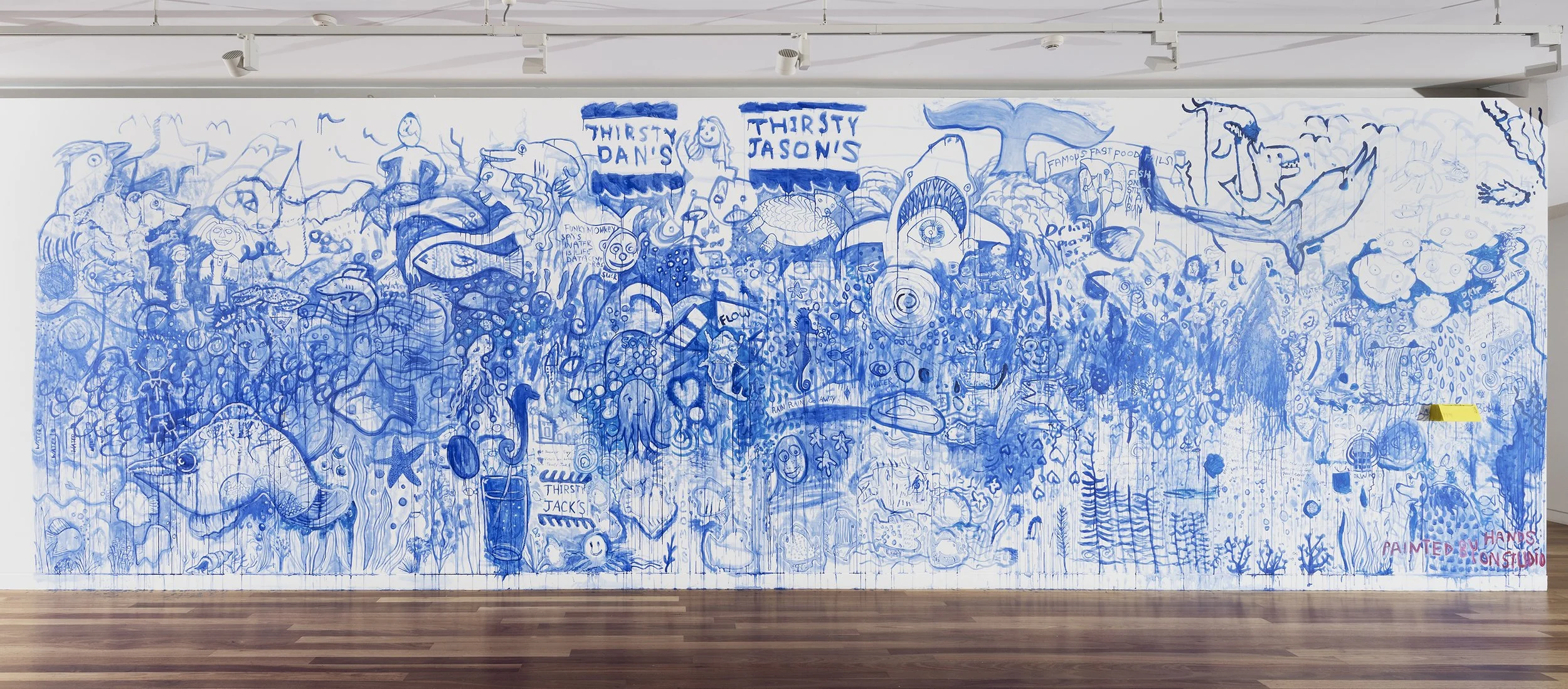
Hands On Studio. Installation view of the collaborative ink mural. 2026. Canberra Contemporary. Photograph by Brenton McGeachie.
Water forms complex networks across the Earth, from vast seas to fleeting puddles, pooling, flowing and cutting through the landscape. Water has also played a significant role in shaping history, religion and art, mythologised as both a source of life and death.[14] Each of us carries personal memories and associations with water, for example, the places where we played mermaids as children. At the same time, water is experienced and understood collectively as the means by which we bathe, and the element chemically classified as H2O. In the exhibition Water, Hands On Studio explores water as substance, environment and experience, using a wide range of materials and techniques to do so.
The ink mural draws audiences into a playful and fantastical world, materially expressing the ideas, experiences and imagination of the Hands On Studio artists. Installed along a narrow corridor, the mural forms a liminal threshold that invites people to pause before entering the exhibition. Its intricate, layered composition resists quick viewing, created collaboratively between eighty-one artists across several days. The extended surface becomes a site for experimentation and storytelling, bringing together people, objects, creatures, scenes and lines of text. As watery layers of blue ink unfold, specific imagery and motifs emerge: aquatic creatures swimming along the ocean floor; food and beverage signs advertising fish, chips and bottled water; and mermaids lounging at the water’s surface. Drawing on traditions of mural painting and public art, the work is site-specific and temporary, destined to be painted over upon the conclusion of the exhibition. As a product of collaborative making between the Hands On Studio artists, the mural has become an important site for – and representation of – disability community and culture.
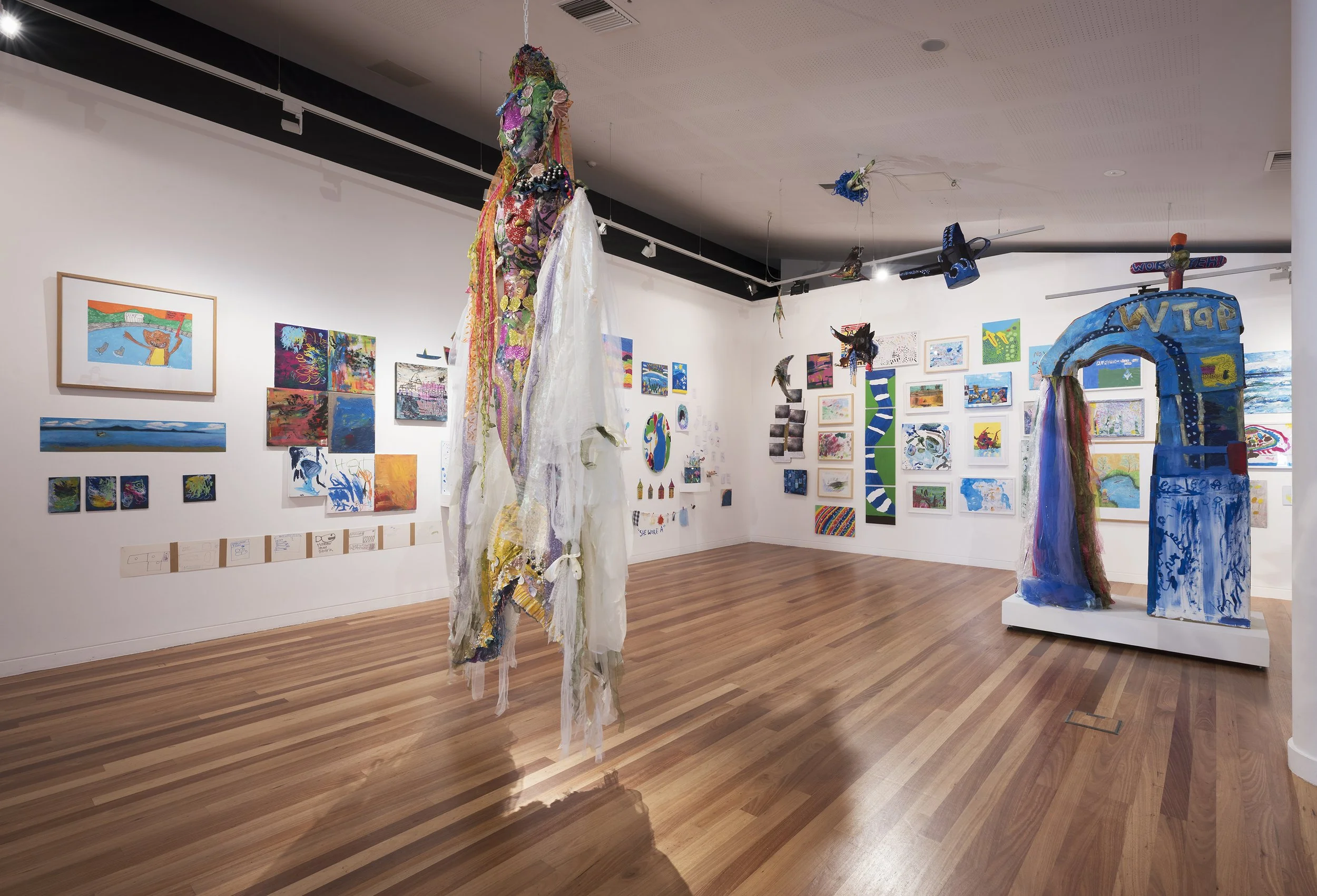
Hands On Studio. Installation view of Water. 2026. Canberra Contemporary. Photograph by Brenton McGeachie.
The exhibition Water includes several striking sculptures that further animate the ideas of the Hands On Studio artists. Constructed from textured, additive materials – including paper mâché, textiles, found objects, beads and acrylic paint – the works consciously depart from sculptural tradition. The resulting forms are joyful, colourful and personal, reflecting the individuals who made them and the moment of their creation. Water demonstrates the power of a community arts collective such as Hands On Studio, bringing together dozens of different artists and centring collaboration as both a method and outcome.
Contemporary art has increasingly prioritised social engagement and political affect, all but replacing the figure of the sole artist-genius with collaborative and collective approaches.[15] Emerging through generative exchange and shared labour, collaborative artworks privilege practices that are public, participatory and process based.[16] These approaches prove especially powerful for disability art and studies, which continue to develop in the spaces outside and between disciplinary, organisational and institutional boundaries.[17]
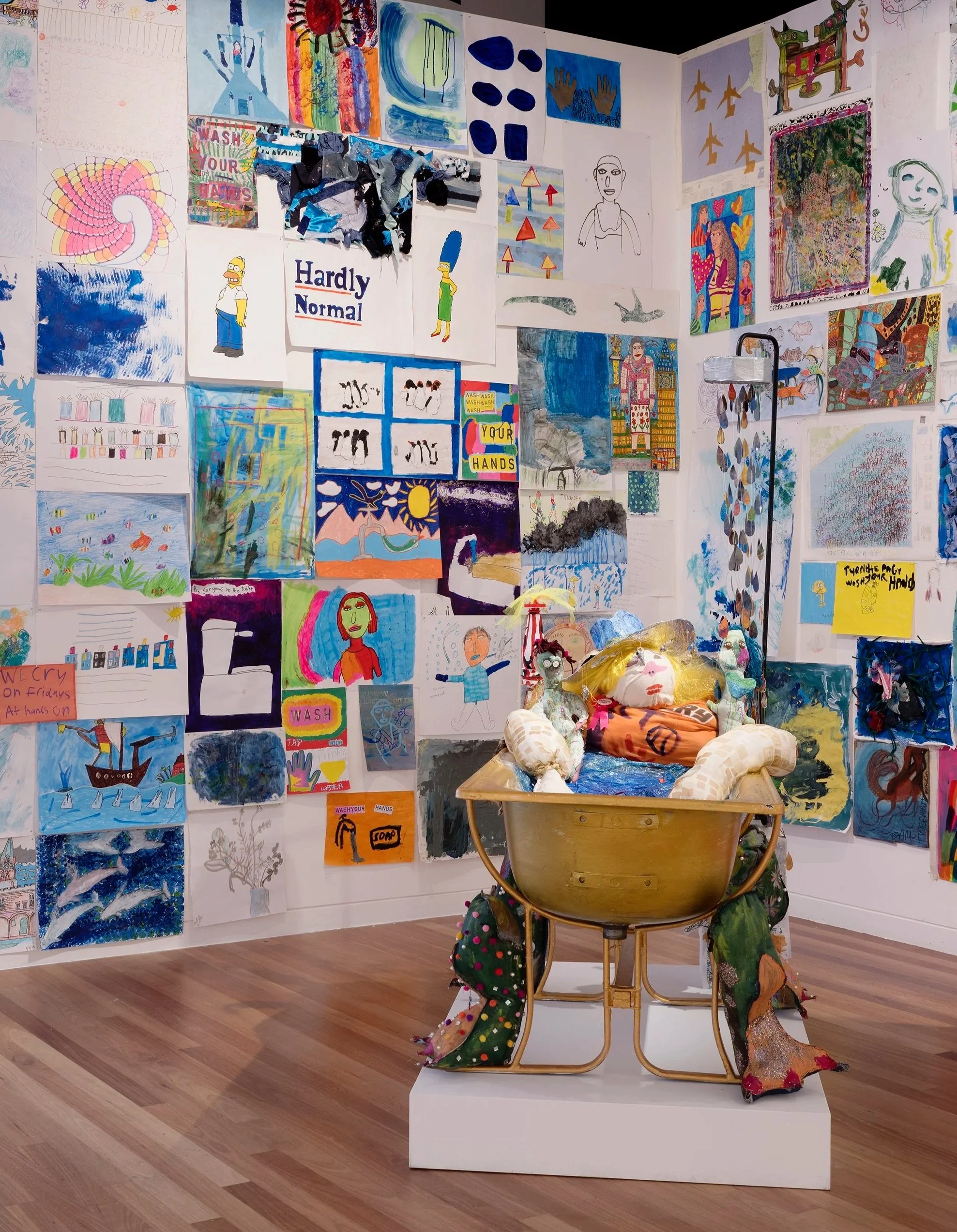
Hands On Studio. Installation view (detail) of Water. 2026. Canberra Contemporary. Photograph by Brenton McGeachie.
Leaving the exhibition Water, visitors encounter a multimedia sculpture depicting a reclining figure in a gold bathtub, supported by colourful frog legs. The sculpture evokes the familiar calm of a bath, set within an imaginative and storied scene. Rising along the corner wall behind is a wide array of paper-based works, recalling the eighteenth-century European salon hang. This historical mode of display arranges works in close rows extending from floor to ceiling, forming an immersive mosaic of mediums, styles and subjects. Together, these works offer glimpses into the vital role of water in our daily lives, circulating through natural, environmental cycles alongside human-made systems of concrete, pipes and faucets. Through the creative exchange of memories, experiences and ideas, Amy Claire Mills and the Hands On Studio artists frame water as a sustaining, caring and joyful force.
[1] Elif Shafak, There Are Rivers in the Sky. (Alfred A. Knopf, 2024), 19.
[2] Tobin Siebers, Disability Aesthetics. (University of Michigan Press, 2010), 2.
[3] Cachia, Amanda, ed. Curating Access: Disability Art Activism and Creative Accommodation. (Taylor & Francis Group, 2022), 1-2, https://ebookcentral.proquest.com/lib/anu/detail.action?docID=7047889#.
[4] Juliet Phraser. ‘Crip Time in the Deep End: An Auto-Fiction Response by Juliet Phraser,’ Canberra Contemporary, published February, 2026, https://www.canberracontemporary.com.au/juliet-crip-time-in-the-deep-end.
[5] Robert McRuer and Emma Cassabaum. ‘Crip Theory,’ Oxford Bibliographies, published May 26, 2021, https://www.oxfordbibliographies.com/display/document/obo-9780190221911/obo-9780190221911-0109.xml.
[6] McRuer and Cassabaum, ‘Crip Theory.’
[7] Karin Ljuslinder, Katie Ellis and Lotta Vikström, ’Cripping Time – Understanding the Life Course through the Lens of Ableism,’ Scandinavian Journal of Disability Research: SJDR 22, no. 1 (2022): 36, https://doi.org/10.16993/sjdr.710.
[8] Alison Kafer, Feminist, Queer, Crip. (Indiana University Press, 2013), 26-7, https://ebookcentral.proquest.com/lib/anu/detail.action?docID=1189107#.
[9] Ljuslinder, Ellis and Vikström, ’Cripping Time – Understanding the Life Course through the Lens of Ableism,’ 36.
[10] Beatrice Alder-Bolton, ‘On Marta Russell’s Money Model of Disability,’ Blind Archive (Substuck), posted December 13, 2021, https://blindarchive.substack.com/p/marta-russell-money-model-of-disability.
[11] Kafer, Feminist, Queer, Crip, 26.
[12] Ibid, 26.
[13] Amy Mills. ‘Deep End,’ Canberra Contemporary, published February, 2026, https://www.canberracontemporary.com.au/current/amy-claire-mills-deep-end.
[14] Maarja Kaaristo, ‘Waterway: A liquid place,’ In The Routledge Handbook of Place, ed. Tim Edensor, Ares Kalandides and Uma Kothari (Routledge, 2020), 168, https://doi.org/10.4324/9780429453267-14.
[15] Grant Kester, The one and the many: contemporary collaborative art in a global context. (Duke University Press, 2011), 7-8. https://doi.org/10.1515/9780822394037.
[16] Kester, The one and the many, 9.
[17] Kristin Lindgren, Amanda Cachia and Kelly George, ‘Growing Rhizomatically: Disability Studies, the Art Gallery and the Consortium,’ Disability Studies Quarterly 34, no. 2 (2014), doi: https://doi.org/10.18061/dsq.v34i2.4250.
References
Alder-Bolton, Beatrice. ‘On Marta Russell’s Money Model of Disability.’ Blind Archive (Substuck), December 13, 2021. https://blindarchive.substack.com/p/marta-russell-money-model-of-disability.
Cachia, Amanda, ed. Curating Access: Disability Art Activism and Creative Accommodation. Taylor & Francis Group, 2022. https://ebookcentral.proquest.com/lib/anu/detail.action?docID=7047889#.
Kaaristo, Maarja. ‘Waterway: A liquid place.’ In The Routledge Handbook of Place. Edited by Tim Edensor, Ares Kalandides and Uma Kothari. Routledge, 2020. https://doi.org/10.4324/9780429453267-14.
Kafer, Alison. Feminist, Queer, Crip. Indiana University Press, 2013. https://ebookcentral.proquest.com/lib/anu/detail.action?docID=1189107#.
Kester, Grant. The one and the many: contemporary collaborative art in a global context. Duke University Press, 2011. https://doi.org/10.1515/9780822394037.
Lindgren, Kristin, Amanda Cachia and Kelly George. ‘Growing Rhizomatically: Disability Studies, the Art Gallery and the Consortium.’ Disability Studies Quarterly 34, no. 2 (2014). doi: https://doi.org/10.18061/dsq.v34i2.4250.
Ljuslinder, Karin, Katie Ellis and Lotta Vikström. ’Cripping Time – Understanding the Life Course through the Lens of Ableism.’ Scandinavian Journal of Disability Research: SJDR 22, no. 1 (2022): 35–38. https://doi.org/10.16993/sjdr.710.
McRuer, Robert and Emma Cassabaum. ‘Crip Theory.’ Oxford Bibliographies. Published May 26, 2021. https://www.oxfordbibliographies.com/display/document/obo-9780190221911/obo-9780190221911-0109.xml.
Mills, Amy. ‘Deep End.’ Canberra Contemporary. Published February, 2026. https://www.canberracontemporary.com.au/current/amy-claire-mills-deep-end.
Phraser, Juliet. ‘Crip Time in the Deep End: An Auto-Fiction Response by Juliet Phraser.’ Canberra Contemporary. Published February, 2026. https://www.canberracontemporary.com.au/juliet-crip-time-in-the-deep-end.
Shafak, Elif. There Are Rivers in the Sky. Alfred A. Knopf, 2024.
Siebers, Tobin. Disability Aesthetics. University of Michigan Press, 2010.